

If you’ve got trees near your house and you’re starting to wonder whether they’re a problem, you’re not alone. It’s one of the most common concerns homeowners in Macomb County bring up, and honestly, it’s a smart thing to pay attention to. The good news is that “too close” isn’t always as scary as it sounds, but knowing what to look for can make a real difference.
How Close Is Too Close? It Depends on More Than Just Distance
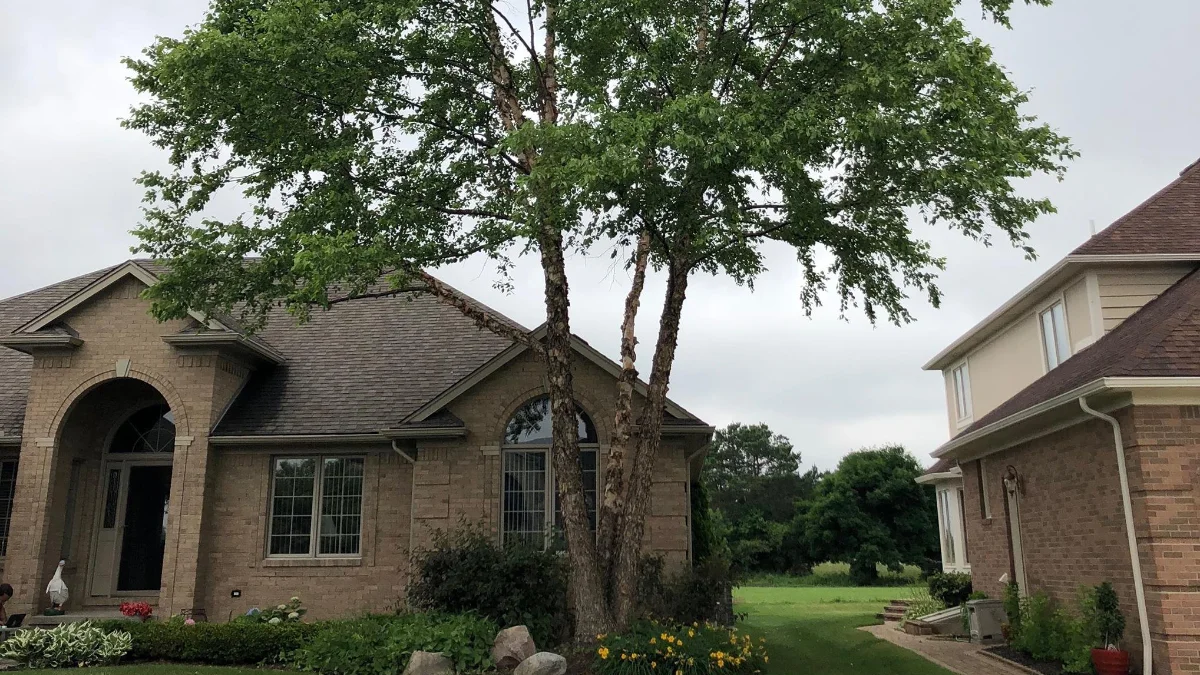
Here’s the thing: there’s no single magic number that makes a tree safe or dangerous based on distance alone. The species, the size at maturity, the tree’s current health, which way it leans, and what’s underneath it all factor into the picture. A healthy 20-foot serviceberry sitting 12 feet from your front door in Clinton Township is a very different situation than a dying 60-foot silver maple at the same distance.
That said, general distance guidelines do give you a useful starting point. Small trees that top out under 25 feet at maturity are generally safe to plant 10 to 15 feet from a structure. Medium trees in the 25 to 50 foot range do better with 15 to 20 feet of clearance, and large trees over 50 feet at maturity really should have 20 to 30 or more feet between them and your house. These are planting guidelines, though. If you’ve got an existing tree that’s already closer than this, that doesn’t automatically mean you’ve got a crisis on your hands.
What Actually Creates Risk When a Tree Is Near Your Home
The risk isn’t usually the tree just “being close.” It’s specific conditions that develop over time. Let’s break down the real problem areas so you know what to actually watch for.
Overhanging branches are one of the most common culprits. Branches rubbing against your roof shingles cause wear that adds up fast, and in a place like Macomb County where we get serious ice storms and high winds, that friction damage can shorten a roof’s life by years. Beyond the rubbing, branches hanging over your roofline create what’s basically a debris conveyor belt straight into your gutters: leaves, twigs, seeds, and all of it. And dead or weakened branches hanging over your house? Those are a direct structural risk the moment a storm rolls through.
Root proximity to your foundation is a concern, but it’s probably less scary than you’ve heard. Roots don’t actually “attack” foundations. They follow moisture. The real concern in Macomb County specifically is clay soil desiccation. (Stay with me here, because this one matters for our area.) Macomb County has clay-heavy soil in many neighborhoods, and when large tree roots pull significant moisture out of that clay during dry summers, the soil can shrink and shift, causing settlement under your foundation. Roots can also exploit existing cracks in older foundations, but a solid, crack-free foundation is not typically at risk from roots alone.
Sewer lines are another legitimate concern, especially in older Macomb County neighborhoods. Older clay tile sewer pipes, which are common in established areas around St. Clair Shores and parts of Clinton Township, are particularly vulnerable because roots can enter through joints and small cracks and grow inside the pipe over time. Water lines can be affected too, but sewer lines are where most of the real-world problems show up.
Tree lean is something a lot of homeowners overlook. A tree leaning toward your house carries more risk than a straight tree at the same distance, full stop. And when you combine a noticeable lean with signs of root decay or soil heaving around the base, that’s a serious warning sign that deserves professional attention sooner rather than later.
Finally, the health and structural integrity of the tree matters enormously. A healthy, well-structured tree 15 feet from your house may genuinely be less of a risk than a declining tree 30 feet away. Hollow trunks, large cavities, and significant decay change the entire risk calculation. The distance number becomes almost secondary when the tree itself is compromised.
Michigan-Specific Hazards That Make This More Complicated
Living in Michigan, and specifically in Macomb County, adds some layers that homeowners in other states don’t have to think about as much. Ice storms are a big one. Michigan ice storms add enormous weight to branches, and we see significant ice events in this part of the state regularly. Branches that look perfectly fine in October can become a serious hazard by February.
If you live in Harrison Township or St. Clair Shores, you’re also dealing with lake-effect wind off Lake St. Clair. Those wind events can be surprisingly intense, and they put extra stress on any tree that’s already leaning or structurally compromised. It’s worth factoring that in when you’re evaluating trees on the lake-facing side of your property.
Emerald ash borer is another issue that’s hit Macomb County hard. If you have an ash tree near your home that’s been declining, pay close attention. Dead ash trees become brittle faster than almost any other species, and a structurally compromised ash near a structure is a genuine risk that tends to move from “watch it” to “urgent” pretty quickly. According to data from NOAA’s National Centers for Environmental Information, Michigan averages over $100 million in weather-related property damage annually, and falling trees and branches are a consistent contributor to that total. You can learn more about how trees interact with structures from the Michigan State University Extension at canr.msu.edu, which has solid research-based guidance for Michigan homeowners.
Spring also brings saturated soils, and wet soil significantly reduces how well a tree’s root system anchors it in the ground. Large trees in clay-heavy Macomb County soil after a wet April are more susceptible to wind-throw than most people realize.
Signs a Tree Near Your Home Needs Attention Now
Some warning signs are obvious and some aren’t. Here’s what to look for when you’re doing a walk-around of your property.
Branches that are physically touching or rubbing your roof need to be addressed. Dead branches hanging over the structure are a priority. A lean toward the house that you’ve noticed increasing over time is a red flag, as is soil heaving or cracking around the base of the trunk. Knock on the trunk: a hollow sound where you’d expect solid wood is a problem. Fungal growth at the base or on the trunk, including mushrooms or shelf-like conks, often signals internal decay. Significant dieback in the canopy, where large sections of the tree aren’t leafing out properly, is also a sign the tree is struggling in ways that may affect its structural integrity.
If you’re seeing two or more of these signs together, don’t wait on it. That’s when you want professional eyes on the tree before the next storm season.
What You Can Do About a Tree That’s Too Close
Removal isn’t always the answer, and it’s often not the first option. There are several ways to manage a close tree depending on the actual situation.
Crown raising involves removing the lower limbs to create clearance between the canopy and your roofline without taking the tree down. Done right, this is often all that’s needed for an otherwise healthy tree. Crown reduction reduces the overall size of the canopy, which lowers the risk profile of the tree. It’s important that this is done correctly by someone who knows what they’re doing. Topping a tree, which is flat-cutting the top off, is not crown reduction and actually creates long-term problems by generating weak, fast-growing regrowth. If you’re dealing with overhanging branches or branches near your roofline, tree trimming and pruning to create safe clearance around your home is often the most practical and cost-effective first step.
For new plantings, root barriers can be installed to direct root growth away from foundations and utility lines. And when a tree is genuinely a structural risk, either from significant decay, disease, or a combination of factors that make it unmanageable, full removal is the right call. If you need professional tree removal services from Bucket Baby Tree Service in Macomb County, that option is always available when a tree has reached that point.
Choosing the right tree in the right place matters a lot for future headaches. Small ornamental trees like serviceberry, redbud, and dogwood are great choices for planting close to structures because they stay manageable. On the flip side, silver maple, cottonwood, willow, and large oaks really shouldn’t be planted within 20 feet of a structure. They’ll outgrow the space and create the exact problems we’ve been talking about.
When to Call a Professional
You don’t need to be certain something is wrong to get a professional opinion. Any time you’re genuinely unsure about a tree near a structure, getting an arborist out is a reasonable thing to do. Before storm season is a smart time to schedule an assessment if you have any concerns. After a storm is also important, because hidden damage from high winds or ice loading isn’t always visible from the ground.
If you want to be proactive, schedule a FREE assessment with Bucket Baby Tree Service before the next big storm season hits.
Frequently Asked Questions
How do I know if my tree is actually too close to my house?
Honestly, distance alone doesn’t tell the whole story, and that’s something we explain to homeowners all the time at Bucket Baby Tree Service. What you really want to look at is whether branches are touching the roof, whether the tree has a lean toward the structure, and what the overall health of the tree looks like. I’ve seen trees in St. Clair Shores that were 10 feet from a house and totally fine because they were small, healthy ornamentals. I’ve also seen trees 25 feet away that were a serious concern because of decay and lean. If you’re in Macomb County and you’re not sure, just get someone out to take a look.
Can tree roots damage my foundation?
This is one of the most common questions we get, and the honest answer is: it’s less common than people fear, but it’s not zero risk either. Roots don’t seek out foundations to attack them. They follow water and nutrients. The bigger concern in Macomb County is actually clay soil. When large tree roots pull moisture from clay-heavy soil during dry periods, the soil can shrink and shift under your foundation. At Bucket Baby Tree Service, we see this more in older neighborhoods in Clinton Township and Harrison Township where big trees have been growing near homes for decades. If you’ve got clay soil and a large tree close to the house, it’s worth having a conversation with a professional.
What trees are most dangerous when they’re close to a house?
In Macomb County specifically, we watch silver maple, ash trees affected by emerald ash borer, and cottonwood pretty closely when they’re near structures. Silver maple has a reputation for weak branch structure, and it’s one of the most common trees we get called about after wind events in areas like St. Clair Shores and Clinton Township. Ash trees that are declining from EAB become brittle fast, and once an ash is dead, the window to deal with it safely closes quicker than most people expect. At Bucket Baby Tree Service, we always factor in species when we’re doing a risk assessment, because not all trees behave the same way.
Do I need a permit to remove a tree near my house in Macomb County?
Permit requirements vary by municipality, so the answer depends on exactly where you are. Some communities in Macomb County have tree ordinances that require a permit for removal of trees above a certain trunk diameter, and some don’t. At Bucket Baby Tree Service, we’re familiar with the rules in the communities we serve, including Clinton Township, St. Clair Shores, and Harrison Township. When we come out for a free estimate, we can talk through what the local requirements look like for your specific address so there are no surprises. It’s always worth checking before you cut anything down.
How often should I have trees near my house professionally inspected?
A good rule of thumb is every three to five years for healthy trees, and every year or two if you’ve got a large tree close to a structure or a tree that’s shown any signs of stress. In Macomb County, we’d also recommend a check after major ice storms or high wind events off Lake St. Clair, because damage isn’t always obvious from the ground. At Bucket Baby Tree Service, we offer free estimates and assessments, so there’s really no reason to go years without having someone take a look if you’ve got trees near your home. We serve the whole Macomb County area and we’re happy to come out and give you an honest picture of what you’re working with.
Knowing what to look for and understanding the real risk factors puts you in a much better position than just eyeballing a tree and guessing. Most close trees are manageable with the right care, and knowing the difference between a watch-and-wait situation and an urgent one is genuinely valuable knowledge for any homeowner.
Worried About a Tree Near Your Home in Macomb County?
Bucket Baby Tree Service serves Clinton Township, St. Clair Shores, Harrison Township, and all of Macomb County. Whether you need a professional assessment, trimming to create safe clearance, or full removal, our certified arborist and crew are ready to help. Visit bucketbabytreeservice.com to request your FREE estimate!